

Product development teams today face mounting pressure. Products are more complex. Timelines are tighter. Quality and compliance expectations are higher than ever. And while organizations invest heavily in tools, processes, and transformation initiatives, many still struggle to see meaningful improvement. This is often because teams are trying to fix problems they don’t fully understand.
That’s where a product development assessment comes in. Rather than jumping straight into new tools or large-scale change, assessments provide a structured way to understand current-state performance, identify root causes, and prioritize improvement efforts.
In this blog, we’ll explore what a product development assessment is, the types EAC offers, how outcomes differ with and without an assessment and other important assessment differentiators. Ultimately, we’re here to help you select the right product development assessment.
What Is a Product Development Assessment?
A product development assessment is a structured evaluation of how an organization designs, develops, and delivers products. It examines the intersection of people, processes, tools, and data across the product lifecycle.
Importantly, an assessment is not about creating documentation for its own sake. It’s about turning activity into insight, moving beyond surface-level symptoms to understand what’s really driving delays, rework, risk, or inefficiency.
Where ad hoc reviews often generate opinions, assessments are designed to create shared clarity and actionable direction.
What an Assessment Typically Evaluates
While scope varies by organization, most product development assessments examine areas such as:
- Process maturity and consistency across teams and programs
- Tool usage and integration, including where systems help (or hinder) product development
- Collaboration and handoffs between engineering, manufacturing, quality, and other stakeholders
- Risk, quality, and change management practices
- Alignment between engineering execution and business objectives
Together, these insights help organizations understand not just what is happening, but why.
When Organizations Benefit Most from an Assessment
Assessments are especially valuable:
- Before major CAD, PLM, or digital transformation investments
- When scaling teams, products, or global operations
- When experiencing recurring delays, rework, or compliance challenges
- When previous “improvement initiatives” failed to deliver expected results
In these moments, clarity matters more than speed.
Types of Product Development Assessments EAC Offers
EAC offers multiple assessment approaches designed to meet organizations where they are, each focused on delivering insight, not just analysis. Our breakdown below should help you better understand what they offer and help you select the right product development assessment option.
Functional Group Assessment
A Functional Group Assessment focuses on the effectiveness of a specific team or discipline (for example, engineering, quality, or manufacturing).
At a high level, it helps organizations:
- Understand how a function operates day-to-day
- Identify gaps in process consistency, tool usage, and collaboration
- Highlight improvement opportunities within a defined scope
This type of assessment is often used when challenges appear localized but may have broader downstream impact.
Learn more about the Functional Group Assessment
Product Development System Assessment
A Product Development System Assessment takes a broader, end-to-end view of how products move from concept to release.
It evaluates:
- Cross-functional workflows and dependencies
- Systemic bottlenecks and misalignment
- How tools, data, and processes work together… or don’t
This approach is well suited for organizations looking to improve overall system performance rather than isolated pain points.
Learn more about the Product Development System Assessment
With an Assessment vs Without an Assessment
Without an Assessment
When organizations skip an assessment, improvement efforts are often driven by:
- Assumptions or anecdotal feedback
- Tool-first or change-first initiatives
- Incremental fixes that don’t address root causes
The result is a higher risk of disruption without a clear way to measure whether things are actually getting better.
With an Assessment
Organizations that begin with an assessment gain:
- A clear baseline and shared understanding of current performance
- Data-driven prioritization of improvement efforts
- Better alignment across stakeholders
- A focus on sustainable improvement, not just visible change
Change vs Improvement
The key difference is mindset. Change introduces motion. Improvement delivers results. Assessment-led initiatives tend to produce more predictable outcomes because they’re grounded in reality, not assumptions.
DIY Assessments vs EAC-Led Assessments
The Appeal of DIY Assessments
Many organizations attempt internal assessments first, and for good reason:
- Lower upfront cost
- Familiarity with internal processes
- Faster to initiate
DIY approaches often feel like a logical starting point.
Common Limitations of DIY Approaches
However, internal assessments frequently struggle with:
- Internal bias and blind spots
- Inconsistent or informal methodology
- Limited benchmarking against industry peers
- Difficulty translating findings into actionable change
Without structure, insight can stall.
The Value of an External, Structured Assessment
An EAC-led assessment brings:
- An objective, outside perspective
- Proven frameworks grounded in product development realities
- Access to industry benchmarks
- Clear recommendations tied to business impact
The goal isn’t to replace internal expertise. It’s to amplify it.
EAC Assessments vs Traditional Consulting
The Traditional Consulting Model (High Level)
Traditional consulting engagements are often:
- Time-based and report-heavy
- Centered on generalized frameworks
- Limited in ownership transfer once the engagement ends
While they can offer strategic insight, execution and sustainability can be challenging.
EAC’s Assessment-Based Approach
EAC’s model is:
- Grounded in engineering and product development realities
- Outcome-driven and practical
- Designed to inform actionable roadmaps, not just recommendations
The emphasis is on clarity, alignment, and real-world applicability.
Why the Assessment Model Matters
This approach enables:
- A faster path to meaningful insight
- Stronger alignment with technical teams
- More sustainable improvement over time
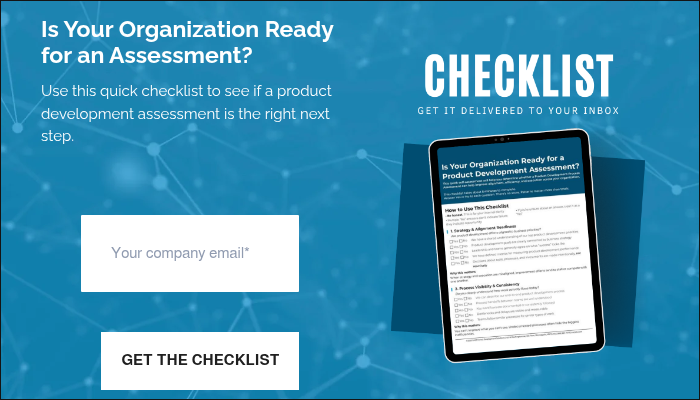
How to Determine If Your Organization Is Ready for an Assessment
Organizations are typically ready for an assessment when:
- Leadership is aligned on the need for improvement
- Teams are willing to examine current practices honestly
- There’s a desire for measurable, sustainable results
An assessment is not a commitment to massive change. It’s a way to make smarter decisions about if, when, and where to improve.
Clarity Before Change
The right product development assessment creates clarity before action. It aligns stakeholders, surfaces root causes, and builds confidence that improvement efforts are focused where they matter most.
Before investing in tools, reorganizations, or large-scale transformations, taking the time to assess your current state can be the difference between change and real improvement.
Is Your Organization Ready for a Product Development Assessment? Use our checklist to find out.

Manufacturers today operate in increasingly complex environments. Product development involves more tools, more data, more teams, and more customer expectations than ever before. As organizations push to innovate faster while keeping quality high and costs contained, even small inefficiencies in the product development ecosystem can create major bottlenecks.
Many teams know something isn’t working, but they can’t see exactly where the misalignment lives.
That’s where a Product Development System Assessment (PDSA) becomes invaluable. A PDSA is a structured, high-impact evaluation of how your people, processes, systems, and data work together across the entire product lifecycle. It provides clarity about hidden inefficiencies, identifies opportunities for improvement, and delivers a prioritized roadmap aligned with your business strategy.
In this article, we break down what a PDSA includes, why companies need it, and the business value it creates for engineering and manufacturing organizations.
What Is a Product Development System Assessment (PDSA)?
A Product Development System Assessment is a comprehensive analysis of your entire product development ecosystem, from concept to engineering to manufacturing and service. Unlike narrow audits focused on tools or isolated workflows, a PDSA evaluates the full system that supports product development.
This includes:
- How teams collaborate
- How processes flow across departments
- How well systems like CAD, PLM, ERP, and IoT integrate
- How product data moves through its lifecycle
- How aligned your operations are with your organizational goals
A PDSA delivers a clear current-state diagnosis and a future-state vision, helping your organization understand not just what is happening, but why, and what steps will unlock measurable improvement.
Why Do Companies Perform a Product Development System Assessment?
Most organizations pursue a PDSA when they’re experiencing friction across their processes but don’t have a reliable way to pinpoint root causes. Common symptoms include:
- Slow product releases
- Rework due to inconsistent data
- Disconnected systems requiring manual workarounds
- Bottlenecks between design and manufacturing
- Confusion around roles, responsibilities, and ownership
- Low adoption of critical tools like PLM, CAD, or ALM
- Lack of visibility across teams or across the digital thread
A PDSA turns scattered issues into a connected story. It creates a fact-based foundation that leaders can use to make smarter decisions about technology investments, process improvements, organizational changes, and digital transformation initiatives.
In short: a PDSA gives you the clarity you need to move from reactive problem-solving to proactive strategic improvement.
When Is the Right Time to Conduct a Product Development System Assessment?
Organizations typically conduct a PDSA when:
- They’re preparing for a major PLM, CAD, ERP, or ALM upgrade or deployment
- They are merging teams or integrating new business units
- Product complexity has grown faster than their systems can support
- Digital transformation initiatives are planned or underway
- Repeated issues are slowing down engineering or manufacturing
- Teams are struggling with inconsistent or manual processes
A PDSA is an ideal starting point when leadership knows improvement is needed but lacks an objective, end-to-end view of where to begin.
What Business Challenges Does a Product Development System Assessment Address?
A PDSA tackles the systemic challenges that impact product development performance. Key issues it uncovers include:
Disconnected or poorly integrated systems: When CAD, PLM, ERP, and other tools don’t work together, teams resort to manual workarounds that slow everything down.
Version control and data consistency problems: Different versions of product data across departments lead to errors, rework, and delays.
Inefficient or unclear processes: Non-standardized workflows or unclear ownership create bottlenecks and confusion.
Limited cross-functional visibility: Teams struggle to understand how upstream or downstream processes affect their work.
Underutilized technology investments: Organizations often own advanced tools but haven’t configured, integrated, or adopted them fully.
By revealing these issues, a PDSA provides the insight needed to streamline workflows, reduce risk, and improve product development outcomes.
What Does a Product Development System Assessment Cover?
A PDSA evaluates four core dimensions of your product development ecosystem:
1. Processes: How work flows from concept to design to production, including: approvals, handoffs, and change management.
2. People: How cross-functional teams collaborate, communicate, and use the tools available to them.
3. Systems: How technologies (PLM, CAD, ALM, ERP, IoT) interact and support your product lifecycle.
4. Data: How information is created, stored, shared, and maintained across teams and systems.
This holistic approach reveals the true health of your product development environment and identifies where improvements will have the highest impact.
Can the Assessment Focus on Specific Areas?
Yes. While a full PDSA is end-to-end, it can also target individual functional areas or processes if needed.
Common focus areas include:
- Change management
- Design-to-manufacturing handoff
- CAD/PLM integration
- Data governance and version control
- Configuration management
- Requirements and ALM processes
- Engineering workflows
- Supplier collaboration
This flexibility allows organizations to use a PDSA where it will deliver the most immediate value.
What Is the Process for Conducting a Product Development System Assessment?
A typical PDSA follows a structured, collaborative process:
1. Discovery & Alignment: Define objectives, scope, and success metrics with leadership and stakeholders.
2. Data Collection & Interviews: Evaluate workflows, tools, organizational structures, and performance insights through documentation, system review, and stakeholder interviews.
3. Analysis: Identify gaps, redundancies, bottlenecks, and maturity levels across processes, teams, and systems.
4. Future-State Visioning: Develop a clear picture of what an optimized, connected product development ecosystem should look like for your organization.
5. Prioritized Roadmap: Deliver a step-by-step action plan with recommended initiatives, ROI-focused priorities, and realistic timelines.
This process creates clarity without disrupting daily operations.
What Deliverables Will You Receive?
At the conclusion of a PDSA, organizations receive a clear, actionable set of deliverables, including:
- Current-State Assessment: Strengths, weaknesses, bottlenecks, and gaps.
- Future-State Vision: What optimized product development looks like.
- Prioritized Roadmap: Specific steps to improve processes, integrations, data flow, and team alignment.
- Executive Summary: High-level insights for leadership decision-making.
These deliverables become the blueprint for technology selection, system upgrades, workflow redesign, and digital transformation initiatives.
Is a Product Development System Assessment a Standalone Service?
Yes. A PDSA delivers immediate, standalone value and does not require additional services. You can use the findings internally or choose to work with EAC Product Development Solutions to implement the roadmap.
Many organizations begin with a PDSA to de-risk future transformation investments and ensure they are prioritizing the right initiatives.
Why a PDSA Matters
A Product Development System Assessment gives manufacturers the deep visibility they need to make better decisions. It transforms scattered frustrations into a cohesive story about how your organization works, and where it can work better.
In a world where innovation speed and product quality define competitive advantage, understanding the health of your product development ecosystem is essential. A PDSA helps you reduce friction, increase clarity, and build a connected, intelligent product lifecycle across engineering, manufacturing, and service.
Ready to discover how efficient your product development system could be? Learn how leading manufacturers reduce friction and accelerate innovation in our guide.

Manufacturers and engineering organizations know inefficiency hides in plain sight. Data silos, manual workflows, disconnected systems, and inconsistent handoffs often create friction across the product development lifecycle, but identifying exactly where those breakdowns occur can be difficult without a holistic, end-to-end view.
A Product Development System Assessment (PDSA) provides that clarity. Unlike narrow, department-level diagnostics, a PDSA evaluates your complete product development ecosystem (people, processes, systems, and data) to uncover root causes of inefficiency and define a clear roadmap for improvement.
But not all assessments, or providers, deliver the same level of insight, objectivity, or actionable recommendations. Choosing the right partner is essential to ensure your organization gets the strategic foundation it needs to elevate performance, strengthen cross-functional alignment, and accelerate digital transformation.
In this guide, we explore the value a full Product Development System Assessment provides, what to look for in a PDSA provider, and how to ensure you select a partner who can deliver meaningful, measurable results.
Business Value Questions
What value and benefits can companies expect from a Product Development System Assessment?
A PDSA offers deep visibility into how your entire product development ecosystem functions today, and where it’s falling short. Organizations gain a comprehensive, objective understanding of how engineering, manufacturing, quality, service, IT, and leadership interact (or fail to).
Key benefits include:
- Clear understanding of system and process inefficiencies
- Insight into data flow and handoff breakdowns
- Improved alignment between teams and business objectives
- Identification of technology underutilization or misconfiguration
- A prioritized roadmap for process improvement and system optimization
The greatest value lies in the assessment’s holistic nature. Instead of focusing on a single area, a PDSA connects all the pieces. This helps leaders see the “big picture” and make smarter, more strategic decisions that drive enterprise-wide results.
How does a PDSA help companies prioritize initiatives and accelerate improvement?
By capturing an end-to-end view of your product development system, the PDSA helps organizations identify high-impact opportunities and sequence them for maximum ROI. The output is not just a list of issues, it’s a structured improvement strategy.
A strong PDSA provider uses proven frameworks, industry benchmarks, and domain expertise to help organizations:
- Rank initiatives by impact and feasibility
- Reduce friction in engineering and downstream processes
- Identify quick wins, foundational improvements, and long-term investments
- Accelerate digital transformation with a clear path forward
This ensures leadership is not guessing about where to start or what to prioritize. Instead, decisions are grounded in data, risk impact, and enterprise value.
What risks can be avoided by performing a PDSA before major projects?
Launching optimization efforts without an accurate baseline often leads to:
- Scope creep
- Misaligned priorities
- Investment in the wrong tools or initiatives
- Rework and wasted resources
- Resistance from stakeholders
- Implementation failures
A PDSA mitigates these risks by ensuring every improvement effort is grounded in reality. It helps organizations avoid “band-aid fixes” and instead build a strong foundation for long-term scalability and performance.
How do PDSA results support leadership decision-making and investment planning?
The assessment creates a fact-based, data-backed understanding of current performance, including:
- Gaps and bottlenecks
- Cross-functional dependencies
- Technology maturity
- Process alignment
- People and role clarity
This detailed view equips leadership with:
- Justification for investment requests
- Clarity for budgeting and resource allocation
- A strategic roadmap for transformation
- A shared vision to align stakeholders
Executives can move forward confidently knowing decisions are grounded in objective analysis, not assumptions or incomplete information.
Fit, Readiness, and Consideration Questions
Is my company ready for a Product Development System Assessment?
Most organizations struggling with collaboration, system performance, or process inefficiencies are ready for a PDSA. Strong candidates typically:
- Use systems like PLM, CAD, ALM, or ERP
- Experience bottlenecks in product development
- Want to align engineering, manufacturing, and service
- Need clarity before upgrading or implementing new technology
The main requirement is willingness to participate in transparent discovery sessions. A skilled provider ensures this process is efficient and minimally disruptive.
If we already completed an assessment in the past, is a PDSA still valuable?
Absolutely. Product development systems evolve quickly. New software, organizational changes, or shifting priorities often create new inefficiencies.
A PDSA acts as a recalibration, validating past progress while uncovering new opportunities. Many organizations use periodic assessments to drive continuous improvement and stay aligned with digital transformation goals.
What are the limitations of a PDSA compared to a more targeted functional assessment?
A PDSA is broad by design. While it evaluates the entire ecosystem, it is not intended to be a deep-dive audit of every individual workflow or system configuration.
However, a holistic PDSA is often the necessary starting point. It reveals where deeper functional analysis is warranted, whether in CAD operations, PLM configuration, manufacturing workflows, or data governance.
How do you choose between a full PDSA and a smaller functional assessment?
Choosing between a full Product Development System Assessment (PDSA) and a functional assessment depends on how clearly you understand the challenges within your organization. If issues span multiple teams (engineering delays, manufacturing rework, inconsistent data, system integration gaps) a full PDSA is the better fit. It provides a holistic view of your product development ecosystem and helps uncover root causes that may not be visible when looking at a single department or system.
A functional assessment is ideal when the pain point is clearly isolated, such as CAD standards, PLM configuration, change management workflows, or manufacturing processes. These assessments go deeper into a specific area to provide tactical, targeted recommendations.
Many organizations start with a PDSA to identify enterprise-wide priorities, then follow up with functional assessments to address the highest-impact opportunities in greater detail.
Industry Use Cases and Scale Questions
Which organizations benefit most from a PDSA?
Organizations that develop complex products, operate in regulated environments, or manage multi-disciplinary engineering teams benefit the most from a PDSA. This includes industries such as aerospace, medical devices, industrial equipment, automotive, electronics, defense, and energy. These are industries where engineering decisions directly impact compliance, cost, quality, and time-to-market.
However, the value isn’t limited to large enterprises. Mid-market manufacturers often see some of the fastest ROI because they typically operate with lean teams who juggle multiple roles across engineering, operations, and IT. When processes are informal or legacy tools haven’t scaled with business growth, even small inefficiencies create significant delays or rework.
Ultimately, any organization seeking clearer visibility, stronger collaboration, and a more connected digital thread is an ideal candidate for a PDSA.
Can the assessment be applied at the product-line or business-unit level?
Yes. A PDSA is fully scalable and can target a single product line, a dedicated engineering group, a manufacturing cell, or a full enterprise deployment.
Starting with a narrower scope is often strategic, especially for organizations early in digital transformation or those with limited bandwidth. Assessing a pilot group or high-impact product portfolio allows you to validate improvements, quantify value, and build momentum before expanding the assessment enterprise-wide.
This modular approach helps teams focus on the areas that will deliver the biggest and fastest wins, while still aligning with long-term transformation goals.
How does the approach scale across digital maturity levels?
A PDSA adapts to organizations across all maturity levels, from companies with manual, paper-based workflows to highly digital organizations already using advanced PLM, CAD, ALM, or manufacturing systems.
- Early-stage maturity:
The assessment identifies baseline issues like inconsistent workflows, lack of version control, manual handoffs, or disconnected systems. Recommendations focus on standardization, foundational governance, and building an initial digital thread. - Mid-stage maturity:
Most organizations here have tools in place but lack adoption, integrations, or optimization. A PDSA highlights where processes are misaligned with system capabilities, where automation can reduce manual work, and how to streamline cross-functional collaboration. - High maturity:
Even sophisticated teams benefit from a PDSA. At this level, the focus shifts toward advanced enablement—model-based enterprise, analytics, connected product data, ALM/PLM/ERP integration, and scaling digital transformation across the enterprise.
Because the PDSA framework is maturity-agnostic, it meets organizations where they are and helps them grow systematically.
Implementation Process and Logistics Questions
What is involved in coordinating and executing a PDSA?
A Product Development System Assessment is designed to be thorough, structured, and minimally disruptive. The provider handles the heavy lifting while your team participates through targeted interviews and information-sharing sessions.
A typical implementation includes:
- Kickoff & Alignment:
Define scope, business objectives, and key concerns. Establish the leadership sponsor and core stakeholders. - Stakeholder Mapping:
Identify and schedule conversations with engineering, manufacturing, operations, quality, IT, product management, and any other functional groups involved in the product lifecycle. - Process & Workflow Evaluation:
Gather documentation, workflow descriptions, screenshots, and system insights to understand how work is performed today. - System & Data Review:
Assess PLM, CAD, ALM, ERP, and related systems, how they integrate, how data flows between them, and where bottlenecks occur. - Cross-Functional Interviews:
Conduct structured sessions to capture user experiences, process challenges, pain points, and improvement opportunities. - Analysis & Maturity Scoring:
Evaluate findings against best practices and industry benchmarks to determine current maturity levels. - Synthesis & Roadmap Development:
Translate observations into actionable recommendations, sequencing, and an improvement roadmap.
The process is designed so leadership stays informed, stakeholders feel heard, and insights emerge organically, not through guesswork.
How long does a PDSA take?
Most assessments take 6–10 weeks, depending on organizational complexity, system landscape, and scope. Shorter assessments (4–6 weeks) are possible for smaller organizations or limited product-line evaluations, while global enterprises or companies with highly regulated processes may require deeper discovery.
The timeline ensures a balance between speed and depth, fast enough to maintain momentum, but comprehensive enough to deliver high-confidence insights.
What internal commitment is required?
Internal time commitments are manageable and structured to minimize disruption:
- Interviews: Typically 60–90 minutes per stakeholder
- Workshops: 1–2 cross-functional sessions
- Information-sharing: Providing existing documentation, workflow diagrams, system access, or example artifacts
The provider leads the process, guides stakeholders through each step, and ensures the assessment produces accurate, actionable results without overburdening your teams.
What happens after the assessment?
After the assessment is completed, you receive a packaged set of deliverables—usually including a current-state summary, maturity model, future-state vision, and a prioritized roadmap.
Teams are then equipped to:
- Launch targeted improvement initiatives
- Plan system upgrades or reconfigurations
- Align process owners across engineering, manufacturing, and IT
- Build a long-term digital transformation strategy
- Prepare for PLM, ALM, CAD, or data governance projects
Some organizations execute improvements internally, while others choose to partner with EAC or bring in additional support.
Post-Assessment and Action Questions
How do organizations turn PDSA findings into real improvements?
Turning insights into outcomes requires structured execution.
Most organizations begin by identifying quick wins, high-value projects, and foundational initiatives. These often include:
- PLM configuration improvements
- CAD workflow standardization
- Enhanced change management processes
- Better integration between engineering and manufacturing
- Data governance and lifecycle documentation updates
- Cross-functional workflow redesign
The roadmap ensures each initiative is sequenced logically, with clear owners and measurable goals. Regular progress reviews and change management support keep the plan on track.
What ensures the roadmap is executed effectively?
Success depends on a combination of:
- Executive sponsorship: Leadership alignment ensures the roadmap is prioritized.
- Clear ownership: Each initiative needs a dedicated leader and accountable team.
- Structured governance: Standing meetings, KPIs, and milestone tracking ensure momentum.
- Change management planning: Training, communication, and stakeholder engagement reduce resistance.
- Technical and process expertise: Skilled partners help avoid missteps and accelerate implementation.
Organizations that combine leadership alignment, strong governance, and expert guidance achieve the fastest and most sustainable improvements.
How often should a PDSA be repeated?
Most organizations repeat a Product Development System Assessment every 18–36 months.
This cadence allows teams to:
- Measure progress against previous recommendations
- Update maturity scores
- Adjust priorities to match new business objectives
- Identify emerging issues created by system changes or organizational growth
- Reassess readiness for major initiatives (such as PLM upgrades or digital thread expansion)
A recurring PDSA becomes a cornerstone of continuous improvement—ensuring your systems, processes, and teams evolve with your business.
Choosing the Right Partner
Selecting the right provider for your Product Development System Assessment is about more than technical expertise. It’s about finding a strategic partner who understands the complexities of modern product development and can deliver insights that drive meaningful change.
EAC Product Development Solutions brings over 25 years of experience helping manufacturers align systems, processes, data, and teams to improve performance and accelerate digital transformation.
Whether your goal is to optimize your engineering workflows, modernize your PLM, or build a more connected digital thread, a PDSA provides the clarity and direction needed to move forward with confidence.
So what does a successful assessment look like? This asset, The Road Map of a Successful Product Development Process Assessment, shows not only the outcome but the steps taken to achieve it.

In today’s highly competitive manufacturing landscape, success depends on more than just having the right software. It requires alignment between people, processes, and technology. This is especially true in product development and engineering organizations where inefficiencies can ripple across the enterprise. A Functional Group Assessment (FGA) is designed to uncover those inefficiencies, identify improvement opportunities, and align departmental workflows to support broader digital transformation goals.
If your company relies on complex tools like PTC Windchill, Creo, or other enterprise systems, an FGA can help ensure your teams are using them effectively, consistently, and collaboratively. Below, we’ll answer some of the most common questions decision-makers have about Functional Group Assessments: what they are, when to conduct one, and how they deliver measurable results.
What is a Functional Group Assessment and why do organizations conduct one?
A Functional Group Assessment (FGA) is a structured evaluation of how specific departments (or “functional groups”) operate within a company’s product development system. It examines the intersection of people, processes, and technology, looking at how each element contributes to or hinders efficiency, quality, and collaboration.
Organizations typically conduct an FGA to gain a clear picture of operational maturity within a specific area like engineering, manufacturing, service, or quality. The goal is to identify gaps between current practices and best-in-class processes, particularly around how teams use digital tools such as Windchill PLM or Creo CAD.
For many organizations, an FGA serves as a reality check: it validates whether their teams are working effectively, if their systems are properly configured, and if there are hidden barriers slowing down product development. The outcome is a set of actionable insights that help drive continuous improvement and maximize the value of existing technology investments.
When should our company consider doing a Functional Group Assessment?
Most companies find an FGA valuable during periods of change or transition: when upgrading systems, onboarding new teams, or expanding digital transformation efforts. If your organization is implementing or reconfiguring Windchill PLM, for example, conducting an FGA beforehand helps ensure that user roles, data workflows, and system configurations align with business objectives.
You should also consider an FGA if your teams are experiencing:
- Frustration with inefficient processes or redundant work
- Difficulty finding or trusting product data
- Bottlenecks in engineering change or document management workflows
- Challenges with system adoption or inconsistent tool usage across departments
In short, a Functional Group Assessment is most effective when your company is ready to evolve, whether that means improving system performance, harmonizing global teams, or optimizing for greater scalability.
Which functional groups should be involved in a Functional Group Assessment?
While every organization structures its product development ecosystem differently, an effective FGA typically includes multiple departments that directly impact product design, production, and lifecycle management. The most common participants are:
- Engineering / Design Teams: Evaluate CAD modeling practices, version control, and collaboration with downstream functions.
- Manufacturing: Review how production teams access design data and manage changes or documentation through PLM.
- Service and Support: Assess how product data, BOMs, and technical publications flow into service workflows.
- Quality Management: Examine traceability, compliance, and issue resolution processes.
- IT / System Administration: Ensure infrastructure, licensing, and performance support ongoing PLM health.
The strength of a Functional Group Assessment lies in connecting these groups. The insights gained from cross-functional collaboration often reveal the biggest opportunities for improvement, especially where departmental silos create friction in the digital thread.
What does an FGA review? What processes, tools, and behaviors are examined?
A Functional Group Assessment takes a comprehensive, holistic view of how your teams operate day to day. It reviews three main dimensions:
- Processes: The assessment looks at workflows, approvals, and data handoffs between teams. Are change requests handled efficiently? Are product structures managed consistently? Are people following standardized procedures, or is every project an exception?
- Tools: Your existing technology stack is reviewed, including: PLM, CAD, ERP, or other systems that support product development. The assessment identifies whether tools like Windchill are configured optimally and whether users are taking advantage of automation or collaboration features.
- Behaviors and Adoption: Even the best systems fail if people aren’t using them effectively. The FGA examines training levels, adoption rates, and user engagement to identify cultural or knowledge barriers that prevent full system utilization.
Together, these findings provide a clear map of where your team stands and where targeted improvements can deliver the biggest ROI.
How long does a Functional Group Assessment typically take and what is the effort required from our team?
The duration of a Functional Group Assessment depends on the scope and number of departments involved, but most assessments are completed within 2 to 4 weeks. The process typically includes interviews, data analysis, and workshops facilitated by EAC’s experts.
From your team, the effort is minimal compared to the long-term benefits. Stakeholders are usually asked to participate in short interviews (30–60 minutes each), provide access to system data or process documentation, and review findings in a final presentation.
The goal is to keep your team focused on their day-to-day work while giving EAC the insights needed to deliver actionable, high-value recommendations. In most cases, companies report that the time spent on the assessment pays for itself through the time and cost savings discovered afterward.
What deliverables come out of the assessment?
At the end of a Functional Group Assessment, your organization receives a comprehensive findings report and a custom roadmap for improvement.
Deliverables typically include:
- Current-State Assessment: A clear, data-driven view of your existing processes, systems, and behaviors.
- Gap Analysis: Identification of where your operations deviate from best practices or where tool underutilization limits efficiency.
- Actionable Recommendations: Prioritized steps to improve performance, whether through process refinement, training, or configuration changes.
- Future-State Roadmap: A visual roadmap outlining achievable goals, timelines, and measurable outcomes for transformation.
This report becomes the foundation for your continuous improvement strategy, helping align leadership, IT, and engineering teams around a shared vision. For organizations using Windchill or other enterprise tools, it also ensures that future investments deliver measurable results.
Why a Functional Group Assessment Matters
A Functional Group Assessment isn’t just a diagnostic exercise. It’s a roadmap for transformation. It helps organizations identify where small changes can create large, measurable gains in speed, collaboration, and innovation.
Companies that invest in FGAs before major system upgrades or process overhauls are often able to reduce rework, accelerate adoption, and achieve higher ROI on their digital investments. By connecting strategy to execution, FGAs turn uncertainty into opportunity. This provides the insights you need to make confident, data-driven decisions about your digital future.
Get Expert Insight into Your Organization’s Performance
If you’re ready to uncover hidden inefficiencies and strengthen your digital foundation, an EAC Functional Group Assessment is the place to start. Our experts will analyze your systems, interview your teams, and deliver a roadmap to align your technology and processes for maximum business impact.
Not quite ready to talk to an expert? Find out what an assessment can do for your company in our guide From Chaos to Clarity.

When companies invest in advanced digital tools like PTC Windchill, Creo, or Codebeamer, they expect measurable improvements: faster collaboration, streamlined workflows, and smarter decision-making. But over time, even the most advanced systems can drift away from their original purpose if processes evolve faster than the technology or if user adoption lags behind.
That’s where a Functional Group Assessment (FGA) comes in. It’s a structured business assessment designed to help organizations evaluate how effectively their teams, processes, and tools align with business goals. Whether you’re looking to improve PLM performance, optimize engineering workflows, or strengthen collaboration across functional groups, committing to an FGA provides the clarity and direction needed to unlock your next level of operational excellence.
Below, we’ll answer key questions decision-makers often have before committing to a Functional Group Assessment, and what you can expect along the way.
What are the business benefits of doing a Functional Group Assessment?
A Functional Group Assessment helps organizations achieve greater efficiency, alignment, and ROI from their technology investments. By evaluating how each department interacts with tools, data, and processes, the assessment identifies opportunities for productivity improvement and waste reduction.
One of the biggest benefits is tool utilization: uncovering where critical systems like PLM or CAD are underused, misconfigured, or disconnected from the broader product development ecosystem. Many companies discover that features they already own could solve daily bottlenecks, saving time and cost without additional software purchases.
Beyond efficiency, FGAs foster cross-departmental alignment. Engineering, manufacturing, and service teams gain a shared understanding of how their workflows connect, creating a stronger digital thread across the organization. In short, the FGA delivers a roadmap that turns insight into measurable improvement. This drives smarter decisions, better collaboration, and stronger performance at every level.
How do we choose between doing an internal review vs. contracting an external assessment like EAC’s FGA?
While internal reviews can provide valuable feedback, they often lack the objectivity and breadth of expertise that an external partner brings. An internal team may know the symptoms of inefficiency (slow approvals, version control issues, or low adoption) but they may not know the root causes or the industry best practices to fix them.
An external assessment like EAC’s Functional Group Assessment combines independent evaluation with deep experience across hundreds of manufacturing environments. EAC consultants benchmark your processes against industry standards, revealing gaps and opportunities that are often invisible from inside the organization.
Additionally, external assessments eliminate internal bias and department-driven assumptions. Because recommendations are data-backed and vendor-neutral, leadership teams can make confident decisions on where to focus resources for maximum impact. For companies seeking transformation, an external FGA provides both clarity and credibility in the path forward.
What metrics should we track to measure the success of the Functional Group Assessment and its follow-up actions?
To measure the success of an FGA, it’s important to define key performance indicators (KPIs) before and after the assessment. These metrics should align with your business goals and reflect both operational efficiency and technology adoption. Common metrics include:
- System utilization and uptime: Are teams using Windchill, Creo, or other digital tools more effectively and consistently?
- Cycle time reduction: How much faster can your organization move through design changes, releases, or approvals?
- User adoption rates: Are more employees actively engaging with the system following process improvements or training?
- Rework or error reduction: Have duplicate efforts or data discrepancies decreased after process alignment?
- Business goal alignment: Are teams meeting project deadlines, quality standards, and cost objectives more consistently?
Tracking these KPIs provides measurable proof of progress, and ensures the assessment leads to tangible business outcomes rather than just documentation. Many EAC clients integrate their findings into continuous improvement plans or quarterly performance reviews, maintaining visibility long after the assessment ends.
How do we prepare our team and functional groups for participation in an assessment?
Preparation is key to getting the most out of a Functional Group Assessment. Before the assessment begins, leadership should communicate the purpose and value clearly to all participants. The goal isn’t to find fault, but to uncover opportunities for improvement and make everyone’s work easier, faster, and more consistent.
A strong preparation plan includes:
- Identifying participants: Include representatives from engineering, manufacturing, quality, IT, and other groups connected to product data.
- Gathering documentation: Collect process maps, workflow charts, or tool usage reports that show how current systems function.
- Scheduling interviews and workshops: Plan sessions for each team so evaluators can observe how work gets done and where pain points exist.
- Setting expectations: Ensure teams know the process will be collaborative and that feedback is confidential and solution-focused.
When employees understand the assessment’s intent and outcomes, they’re more likely to provide honest insights, leading to more meaningful results and a higher return on investment.
How are results from the assessment used to improve alignment, tool utilization, and process efficiency?
Once the Functional Group Assessment is complete, your organization receives a detailed findings report and improvement roadmap. These results serve as both a baseline and a blueprint for ongoing progress.
The findings typically highlight specific areas where processes, data flows, or technology configurations can be improved. For example, the assessment may uncover:
- Manual steps in workflows that can be automated through PLM configuration
- Inefficient change control or document management procedures
- Lack of integration between CAD and manufacturing systems
- Low system adoption rates due to insufficient training or unclear roles
Using these insights, leadership can prioritize the most impactful initiatives. Those might include improving data traceability, refining approval processes, or standardizing tool usage across teams. Over time, this leads to stronger alignment between business goals and day-to-day operations, reduced redundancy, and more predictable project outcomes.
Do we need to purchase additional services after the assessment, or can it stand alone?
A Functional Group Assessment can absolutely stand alone as a complete, actionable engagement. Many organizations use the findings as a strategic guide for internal improvement efforts, identifying what to focus on and how to measure progress without committing to additional services.
However, companies often choose to extend their engagement with partners like EAC to accelerate results. EAC offers complementary services such as:
- Process optimization workshops to implement recommended changes
- Windchill administration or managed services for ongoing system health and uptime
- Training and mentoring to strengthen user adoption and capability development
- Follow-up assessments to track progress and recalibrate strategies
In essence, the FGA provides a roadmap, and partnering further ensures your teams reach their destination efficiently. Whether you manage improvements internally or with continued support, the clarity gained from the assessment remains invaluable.
Turning Insight Into Sustainable Improvement
Committing to a Functional Group Assessment is more than just a one-time exercise. It’s a strategic investment in clarity, efficiency, and alignment. The process delivers a 360-degree view of how your teams, tools, and processes function together, revealing actionable insights that translate directly into measurable business performance.
By partnering with experts like EAC Product Development Solutions, your organization gains access to deep PLM, CAD, and process expertise. This ensures every recommendation is not just theoretical but implementable in real-world manufacturing environments.
Whether you’re navigating a PLM upgrade, struggling with adoption challenges, or simply looking to maximize your technology ROI, an FGA helps you understand where you stand and where to go next.
Ready to uncover opportunities for improvement? Explore the comparison of what it might look like to go forward with an assessment versus continuing on without one.
