
On November 20, 2018, PTC announced the ~$70M acquisition of an advanced generative design software company named Frustum Inc. Frustum’s technology leverages artificial intelligence (AI) to generate design options in a process called “generative design.” It will be worth your time to follow this acquisition and how PTC incorporates the technology into their flagship offerings. It should be a transformative addition to PTC’s Creo portfolio.
Frustum offers patented desktop and cloud-based engineering software from their headquarters in Boulder, CO. Their software enables engineers and designers to go beyond the limits of their personal experience by leveraging powerful AI capabilities that guide the discovery of high-performance, next-generation product designs.
When asked about the acquisition, Jim Heppelmann, President and CEO of PTC said “PTC is pushing the boundaries of innovation with this acquisition…Creo is core to PTC’s overall strategy, and the embedded capabilities from ANSYS and, later, Frustum will elevate Creo to a leading position in the world of design and simulation. With breakthrough new technologies such as AR/VR, high-performance computing, IoT, AI, and additive manufacturing entering the picture, the CAD industry is going through a renaissance period, and PTC is committed to leading the way.”
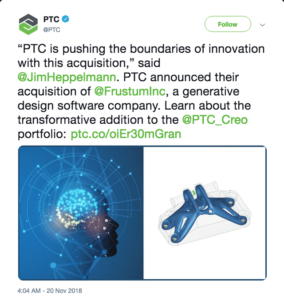
Earlier this year PTC announced a strategic relationship with ANSYS. Frustum complements this relationship and will help bring analysis upstream to the very start of the design process. With embedded Frustum and ANSYS capabilities, Creo will be able to recommend design approaches using generative design, guide the user through the iterative design process using ANSYS Discovery Live, and ultimately validate the full product design at scale using the broader ANSYS Discovery suite. With these capabilities embedded in Creo, engineers will have unmatched capabilities to rapidly drive product innovation.
Here is some more information about the acquisition from the official PTC press release…
“This acquisition is a natural step for PTC and its customers,” said Jeff Hojlo, program director, product innovation, IDC. “AI and machine learning (ML) are widely discussed as two of the most impactful technologies of the future. For design, engineering, and R&D, the potential positive impacts of complementing the development process with AI and ML are astounding: lowering cost of quality (which is currently 20-25 percent of annual revenue at the average manufacturer), improving product success rate (which remains very low with more than 80 percent of products failing), and improving time to market and time to revenue by meeting customer needs accurately the first time.”
The Power of Generative Design
With generative design, engineers can interactively specify the functional requirements and goals of their design, including preferred materials and manufacturing processes—and even indicate key design parameters that take into consideration purchasing decisions, manufacturing capacity, supply chain status, and regional-required product variances. The system then uses AI and powerful high-performance computing techniques to present design alternatives for consideration as a starting point or as a final solution. By removing the constraints of human imagination and experience, engineers will be able to interact with the technology to create superior designs and innovative products more quickly.
Generative design is appealing to PTC’s vast customer base as they seek ways to:
- Increase engineering productivity
- Improve innovation and conceptual design exploration
- Develop higher-performance designs that are lighter weight, with improved durability
- Optimize new products for improved manufacturability, reduce material costs, and decrease manufacturing cycle times
- Create complex geometries optimized for additive manufacturing
- Deliver better products faster
The Impact of Artificial Intelligence
Integral to Frustum’s technology is a powerful AI component that learns, evolves, and, ultimately, performs key tasks, including:
- Providing valuable feedback to a designer early in the design phase
- Optimizing designs for multiple objectives simultaneously and offering a designer with multiple novel design alternatives, which enables companies to substantially reduce engineering cycles
- Modifying designs to manage multiple requirements and constraints, physics, materials availability, manufacturing processes, and design objectives
- Automating testing the outcomes of the design with other enterprise insights, including costing, supply chain, and quality data
The Transaction
The transaction closed on Monday, Nov.19, 2018. The acquisition is not expected to add material revenue for 2019 or to be dilutive to the financial guidance PTC provided on Oct. 24, 2018.
Additional Resources
Forward-Looking Statements
This news release contains statements about future events, including business performance and the effect of the acquisition on our future financial results, the integration and development of solutions, and the expected value of the acquired technology to users. These statements are “forward-looking statements” and actual results may differ materially from those projected as a result of certain risks and uncertainties, including that the acquisition may not have the expected effect on future financial results and that the integration of the solutions may not occur when or as expected, and those risks and uncertainties described in PTC’s filings with U.S. Securities and Exchange Commission. These forward-looking statements reflect our beliefs as of the date of this release and we undertake no obligation to update or revise any forward-looking statement, whether as a result of new information, future events or otherwise.
We transform the way companies design, manufacture, connect to, and service their products.
To fully grasp how we assist and serve our customers, you need to understand our core organizational beliefs:
- We believe the product development process is broken.
- We believe that there is a better way to achieve business initiatives through product development processes and it all starts with learning.
This is exactly why we created the EAC Value Model. We’re a learn first organization. We focus on taking the LAMDA approach.
What is LAMDA?
The LAMDA is a basic learning cycle of lean product and process development. It literally stands for “look, ask, model, discuss, and act.” Ideologically it is a way to learn and optimize within a closed-loop learning cycle that continually looks to improve a situation by defining and improving root-cause issues.
Our LAMDA based EAC Value Model works as follows.
The first phase of the EAC Value Model: Learn
During the learn phase, our specialists take a first-hand approach with your business. This is when we learn about your business initiatives, ask open-ended questions, and gather information so we can truly understand the key drivers of your business’ success, any the root-cause of any potential areas of improvement.
Throughout this phase we take time to learn about your people, your team, your processes, your technology, and the ways of your organization.
We take an in-depth look at your business from front-office to back-office to determine the how your company can extract the most value from its interaction with EAC.
This leads us to the second phase of the EAC Value Model – The Mutually Agreed Upon Plan or M.A.P.
The second phase of the EAC Value Model: The M.A.P.
Using the knowledge acquired from our learning exercise, our team creates a unique customized M.A.P for your organization. Your M.A.P. is a Mutually Agreed Upon Plan that incorporates a multiple step strategy, with actionable steps and business cases for your organization.
This phase provides an understanding of what needs to be accomplished in order to achieve your desired results.
Throughout this process we evaluate solutions that may address your organizational needs. Wither they may be through engineering services, educational training services, product development consultations, system implementation services, software solutions; we configure a plan to fit your specific needs.
The creation of the M.A.P. provides a clear path to value for your organization. It holds everyone accountable for the actions needed to solve business problems and tackle initiatives.
Once we have created your mutually agreed upon plan, the implementation phase begins.
The third phase of the EAC Value Model: Implementation
During the implementation phase we put the M.A.P. into action. This is where our teams move your solution from the developmental stage into production.
You could also refer to this stage as ‘deployment’, ‘go live’, ‘roll-out, or even ‘installation’.
The tasks performed during this phase might include installing or implementing CAD, Windchill, Industrial Automation, IoT or any number of other systems. Perhaps your M.A.P. incorporated training programs for your current teams or additional services for product information. No matter what your plan includes, our team works with you to provide any service, system, or additional skill necessary to achieve your desired results.
Throughout this phase our focus remains on helping your organization become a smart, connected enterprise.
The fourth phase of the EAC Value Model: The Score Card
This is the phase that sets EAC apart. Once we have implemented your solution(s), we never lose focus on gathering feedback on how we did, how a solution is working, or whether the desired outcome or return on investment is being realized…
Remember, our overall goal is to build a long-term relationship with your organization. We feel the best way to do this is by making sure you achieve the success your company needs.
Our business is built around the way your company designs, manufactures, services and connects your products and we recognize, its’ happy customers like you who keep us in business!
With the help of our EAC Score card, we obtain your feedback on how we can continue to help your organization grow.
Our dream for your organization is to create a smart connected enterprise where you have the ability to connect to your products, your shop floor, and know your predictive downtime before it even happens. We make it our priority to help your organization achieve more than you had had imagined.
Stephen Covey’s landmark book ‘The 7 Habits of Highly Effective People’ lists the 7th critical habit as “Sharpen the saw.” It references a parable of a lumberjack and a stranger. The woodsman is very busy cutting down trees. As he completes more and more work his effort increases and his productivity goes down because his saw dulls over time. The lumberjack, exhausted and cursing the labor, is approached by the stranger. “What’s the problem?” asks the stranger. “My saw is dull and won’t cut well” responds the lumberjack. “Why don’t you sharpen it?” asks the stranger. The lumberjack responds “What kind of question is that? Because I would have to stop sawing, and I’m very busy.” The stranger responds “But, if you sharpened your saw you could cut more efficiently than before. You could get even more work done.”
It’s important to sharpen our saw. We need to keep working to improve our knowledge base, approach, and overall situation. This may involve attending a training class, reading a book, mentoring and being mentored, or joining a peer group. I understand this can be difficult in the world of product development / engineering / design / manufacturing / and service. There is always pressure to get to market, get to the trade show, meet customer demands, etc.
Efficient engineering, design, manufacturing, and service requires efficient use of the supporting technologies for each role. Our training group consistently proves a return on our customer’s investment in training and development. That’s because technology keeps getting better. If you don’t know how to take advantage of the full functionality of your tools like PTC Creo, PTC Windchill, PTC Arbortext, and PTC Mathcad…you’re cutting with a dull saw.
We consistently schedule key PTC certified training classes and training courses that help people throughout organizations make the most of their technology. We deliver everything from Windchill Administrator courses to training classes for specific PTC Creo tools and functionality.
Do me a favor. Take time to sharpen your saw. A few days in a training course could save you hundreds of hours down the line. Take a look at the EAC Training Calendar. Maybe you’ll find the perfect PTC training course to put a new edge on your saw. Contact our training group to learn more about our training and mentoring delivery options (Like EACLive!) and full course catalogue. And check out this blog to learn more about how to select a PTC Training Course and Training Class provider.
The EAC Product Development Operating System is a framework that is based on three attributes of the product development system: that it is a competitive system; that its operation requires team-based participation from a broad range of contributors across the organization; and that it changes, evolves or decays, over time.
Many product developers have limited direct contact with their customers or their marketplace and lose sight of the competitive nature of their work. The rows of the PDOS matrix represent the three elements of a competitive system in the context of Product Development. Companies that look to capture the benefit of a competitive advantage from their product development competency cannot do so, without also addressing the needs and requirements of competitive systems.
The concept of teamwork in Product Development is well recognized and valued as a key to effective and efficient operation. Many will immediately think of the cross functional team that executes a project in adherence to an organization’s product development process. But as our model takes a systems view of which the process is a constituent element, our conception of the system team is higher level with the project team just one element of it. Product development system excellence is dependent upon individuals and teams in each hierarchical tier of the organization. These are responsible for supplying input to other subsystem elements of the model essential to these other subsystems’ effective operation. Our model represents this system team element as the columns of the PDOS matrix. These pillars of the system are labeled both with their functional role within the PDOS and with the tier of the organization responsible for that role.
The third attribute of our operating system is that it is dynamic. Without the investment of maintenance or improvement energy, entropy will degrade its structure and operation. On the other hand, a commitment to ongoing improvement will facilitate maturing of the system and carry it through the four levels of our maturity model. Our maturity model includes a system improvement tool that not only accelerates the rate of maturing but also damps the organizational turbulence often characteristic of transitions to a new level of maturity.
The subsystem elements of our model exist in the cells of our matrix. The relative strengths of these elements vary during progress to full maturity; at full maturity the seven elements interact in harmonic balance.
Three elements of a competitive system:
Our most visible competitive systems are sports franchises, and the keys to their success are instructive for business operation:
- Successful teams start with getting on the same page, literally. The team’s knowledge is captured in carefully guarded Playbooks and Game Plans. Everyone understanding the common goal and their role in it is a key to success. Successful, systematic businesses operate with shared goals that are captured in long term strategies, shorter term initiatives, and near term tactical plans.
- Teams invest time and energy in becoming more capable of competing well. The clearest example of this is practice, time spent working on improving the individual and collective skills that are brought to the competition. But the improvement to competence also includes improved infrastructure, equipment, anything that better positions the team to compete. Do businesses generally make this investment in planful improvement to their product development competency with the mind’s eye on the competitive nature of product development?
- And finally there is the competition itself. For teams the competition is head to head, and the metric is clear and clearly displayed on a scoreboard. In product development, the competing occurs in the execution of a program or project. The ultimate metric for product development is its productivity, total value created against the total investment made in creating this value. Execution of a project is the game, execution of the portfolio’s roadmap is the season. The ultimate competitive nature of product development is frequently lost in the common check-box nature of administrative project management.

The rows of the PDOS matrix:
In the EAC Product Development Operating System model, the rows represent the three elements of a competitive system. The Information row establishes the knowledge that must be shared – strategy, initiatives, tactics, process workflows – among all product development team members to create common goals and unify efforts. The Preparation row focuses on the improvement efforts that raise the level of corporate competence. And the Project row is where it all comes together, where we execute the game plan and compete.
Pillars of the System:
The columns of our system represent the pillars of the PDOS. Each pillar has two identifiers; the Product Development sub-team associated with that pillar and the focus of the contributing work done by that sub-team within that pillar.
Knowledge Base:
Knowledge is the Value currency of Product Development, and the PD Knowledge Base supports and glues together the other PD operational subsystems. The PD Information System, beyond housing data and information that serve as the building blocks of PD knowledge, also holds standards, transactional processes’ workflow, and functional tacit knowledge shared between project teammates. PLM has emerged as the critical PDIS tool.
Strategic Planning:
The work that culminates with a successful new product being delivered to market initiates with the development of a Strategic Plan. The compass heading provided by the plan informs decision making throughout the organization, including within the other PDOS subsystems. Critical decisions regarding the investments in the development of core and other competencies, as well as of new products align to the strategy.
Innovation (New Knowledge):
The Innovation subsystem elevates the competitive capability of the organization, its competences. It creates new knowledge in the form of disruptive technologies and novel methods of applying current technologies. It focuses on challenging all existing organizational standards, looking to continuously improve how it operates, and to compete in the marketplace from a position of greater strength and competitive advantage.
Expert Workforce Development:
In any competitive venue, it is understood that success ultimately relies on having great players. The competitive performance of your players is developed outside of the bounds of the competition itself. The intention of, commitment to and execution of investing in all of your product-development-critical subject matter experts – your assets –not only directly results in a more competitive team, but facilitates the recruitment of additional skilled players.
Investment Strategy:
The actual marketplace competition fulfilled by product development begins with strategic decisions about how to execute the product roadmap and elaborate the product portfolio. The informed decisions that lead to the significant investments incurred by product development create both the range and limits on profitability and corporate growth over the mid-range future. This late maturing subsystem determines the level at which you’ll compete.
Knowledge Based Decision Making:
The Knowledge Based Decision Making subsystem is the Product Development sibling to the executive function’s Fact Based Decision Making. While KBDM permeates successful Product Development organizations, in the actual competitive venue of development projects, the critical decisions that are captured as the product Concept are informed by pre-existing and newly generated knowledge of the marketplace and of corporate capabilities.
Project Execution:
The Project Execution subsystem is the part of the Product Development System that in the most narrow of views is seen as Product Development. The realization of the expanded view of the Product Development System does not diminish the critical importance of execution. Supported by new execution paradigms and product development specific information technology tools, longed for improvements in project predictability and reliability are now being achieved.
Tiers of the Organization:
Each of the three tiers in the organizational hierarchy – the executive, the managerial, and the individual functional specialist tiers – makes critical contributions to the effective functioning of a fully developed product development system.
Functional Roles within the PDOS:
The Product Development System Team comprises members in the executive, managerial, and individual subject matter layers of the organization. Each tier of the organization contributes to the effectivity of the system:
Executives set strategic direction, including the investment strategy for product development.
Directors and managers are guardians of critical product development knowledge and responsible for seeing that the right knowledge is available to the right individuals at the right time.
The functional specialists, subject matter experts generate new knowledge and use this and pre-existing knowledge in the execution of product development projects.
Maturity Model:
The EAC Maturity Model is a four level model that distinguishes the degree of structure and organization in the product development system at different periods in the evolution of the competency. The four maturity levels are:
- Tribal & Heroic
- Silo’ed
- Systematic
- Intelligent (self-managing)
System Improvement Tool:
EAC recognizes the value to both the rate of maturing and the ultimate level of maturity that is provided by a well ingrained root-cause problem solving system. The best of these are based on the PDCA cycle, also known as the Deming Cycle. Developed at Bell Labs in the early 20thcentury, and introduced to Japan in the wake of World War II, PDCA played a significant role in the rapid recovery and rise of Japanese industry. A particular version of PDCA was developed by Allen Ward, modeled on the way PDCA is executed at Toyota, and tailored by Ward to suit the way Americans prefer to work.
